Categories
AI Tools

Best AI Tools for Small Business Technology and Automation

Best AI Tools for Small Businesses in 2026

Small businesses are using technology more than ever to compete, save time, and improve customer service. From marketing automation to team collaboration, the best AI tools can help owners do more with less. At the same time, new cybersecurity threats, cloud platforms, and remote work apps are shaping how modern companies operate.

For businesses looking to grow in 2026, the right mix of AI tools for small business, cloud services, and productivity apps can make a major difference. Let’s look at the trends and tools that matter most.

Why AI Matters for Small Businesses

AI is no longer just for large enterprises. Today’s AI business software is easier to use, more affordable, and built for everyday tasks. Small companies can now automate repetitive work, generate content faster, analyze customer behavior, and improve decision-making without hiring large teams.

Common use cases include:

  • Writing marketing copy
  • Managing leads and customer support
  • Automating email campaigns
  • Scheduling content and social media posts
  • Generating reports and insights

The best part is that many business automation software platforms now include AI features by default, making them even more valuable for lean teams.

Best AI Tools for Small Businesses

Choosing the right tools depends on your goals, but a few categories stand out for small business owners.

1. AI Writing and Content Tools

These tools help with blogs, ads, product descriptions, and email campaigns. They save time and keep your content pipeline moving.

Popular uses:

  • Drafting blog outlines
  • Creating social media captions
  • Improving website copy
  • Writing customer-facing emails

2. AI Customer Support Tools

Chatbots and virtual assistants can answer common questions 24/7, reducing the pressure on small support teams. They also help customers get help faster.

Benefits include:

  • Faster response times
  • Lower support costs
  • Better lead capture
  • Consistent service

3. AI Analytics and Reporting Tools

These tools turn raw data into useful insights. They can identify trends, forecast demand, and help business owners make smarter decisions.

For example, small business technology platforms can now automatically summarize sales data, customer behavior, and campaign performance.

4. AI Project and Workflow Tools

Many teams now use productivity AI tools to organize tasks, track deadlines, and reduce manual admin work. These tools help teams stay focused and reduce missed handoffs.

Top Cybersecurity Trends in 2026

As businesses adopt more digital tools, cybersecurity becomes even more important. In 2026, companies must think beyond basic passwords and antivirus software.

Key trends to watch:

  • AI-powered threat detection: Security systems can spot unusual behavior faster than humans.
  • Zero-trust access models: Every login and device must be verified.
  • Ransomware defense planning: Backup systems and response plans are essential.
  • Cloud security management: More data in the cloud means stronger controls are needed.
  • Employee security training: Human error remains one of the biggest risks.

Small businesses are often targeted because attackers assume defenses are weaker. Investing in security is now a business priority, not just an IT concern.

How Cloud Computing Helps Modern Companies

Cloud computing continues to be a core part of modern business operations. It gives teams access to tools, files, and systems from anywhere, which is essential for hybrid and remote work.

Benefits of cloud computing:

  • Scalability: Add users and storage as your business grows
  • Flexibility: Work from any location
  • Lower upfront costs: Reduce the need for expensive hardware
  • Better collaboration: Teams can share and edit files in real time
  • Automatic updates: Software stays current with less effort

For growing teams, cloud platforms also work well with AI business software and automation tools, making it easier to streamline operations.

Best Productivity Apps for Remote Workers

Remote work is here to stay, and the right apps can help teams stay organized and connected. The best tools reduce friction and make communication easier.

Helpful app categories:

Task Management Apps

These help workers stay on top of deadlines, priorities, and team responsibilities.

Communication Apps

Messaging and video tools keep remote teams connected without endless email threads.

Note-Taking and Knowledge Apps

These apps store meeting notes, project details, and company information in one place.

Time Management Apps

Focus timers, calendar tools, and scheduling apps can improve daily productivity.

Many of these tools now include productivity AI tools that suggest priorities, summarize meetings, and automate routine planning.

AI Automation for Digital Marketing

Digital marketing is one of the biggest areas where AI is making a real impact. Small businesses can use automation to reach more people without adding more work.

AI can help with:

  • Email segmentation and personalization
  • Social media scheduling
  • Ad targeting and optimization
  • SEO research and keyword ideas
  • Lead scoring and follow-up workflows

With the right business automation software, marketers can create campaigns that respond to customer behavior in real time. This means better engagement and less wasted effort.

Final Thoughts

The future of small business technology is powered by AI, cloud computing, automation, and stronger cybersecurity. Businesses that adopt the best AI tools now will be better prepared for the demands of 2026 and beyond.

Whether you need better marketing, smoother workflows, or stronger protection, the right combination of AI tools for small business can help your company grow smarter, faster, and more efficiently.

Categories
Online Business

AI in Online Business: How AI Drives Growth and Automation

How AI Is Changing Online Business

Artificial intelligence is no longer a future trend. It is already reshaping how companies operate, market, and grow online. From customer support to content creation, AI in online business is helping brands save time, make smarter decisions, and create better experiences for customers.

For many entrepreneurs, AI is becoming one of the most important forms of digital business technology. It is not just about replacing manual tasks. It is about improving speed, accuracy, and scale in ways that were difficult or expensive before.

Smarter Operations Through Automation

One of the biggest changes AI brings is automation. Repetitive work that once took hours can now be handled in minutes. This is where business automation AI makes a major difference.

Common tasks AI can automate include:

  • Customer service replies
  • Email follow-ups
  • Data entry and reporting
  • Lead scoring
  • Scheduling and appointment booking
  • Product recommendations

By removing routine tasks from the daily workload, teams can focus on strategy, creativity, and customer relationships. That shift helps businesses become more efficient without needing to increase staff at the same pace.

Better Customer Experiences

Customers now expect fast, personalized service. AI helps online businesses meet those expectations more effectively. Chatbots, recommendation engines, and predictive support tools can respond instantly and tailor the experience to each user.

For example, an online store can use AI to suggest products based on browsing history. A service-based company can use a chatbot to answer common questions 24/7. A subscription business can use AI to identify when a customer may be unhappy and intervene before they cancel.

This kind of personalization improves satisfaction and builds trust. In a crowded market, that can make a real difference.

Smarter Marketing and Sales

AI is also changing how businesses attract and convert customers. Marketing teams are using AI business tools to analyze behavior, segment audiences, and create more effective campaigns.

Instead of guessing which message will work, businesses can now test and optimize faster. AI helps answer questions like:

  • Which customers are most likely to buy?
  • What content will perform best?
  • When is the best time to send an email?
  • Which ad creative is driving the most conversions?

Sales teams benefit too. AI can rank leads, predict buying intent, and help reps focus on the opportunities most likely to close. This leads to stronger pipelines and better use of time.

Data-Driven Decision Making

Online businesses generate huge amounts of data. The challenge is not collecting information, but understanding it. AI makes that process easier by identifying patterns humans might miss.

With the right tools, companies can track trends in real time and make faster decisions. This can support everything from pricing and inventory planning to content strategy and customer retention.

For AI for companies, this means better visibility across the business. Leaders can move from reactive decisions to proactive planning. That can reduce risk and improve growth over time.

Content Creation and Productivity

AI is also changing how online businesses create content. Many teams now use AI to brainstorm ideas, outline blog posts, write product descriptions, generate ad copy, and draft emails.

This does not mean content should be left entirely to machines. Human judgment is still essential for voice, accuracy, and brand consistency. But AI can speed up the early stages and reduce creative bottlenecks.

Used well, AI helps teams produce more content without sacrificing quality. That is a major advantage for businesses trying to stay visible across search, social media, and email.

Challenges to Keep in Mind

While the benefits are strong, AI is not a perfect solution. Businesses need to use it carefully. Poorly configured AI tools can lead to errors, generic messaging, or privacy concerns.

Some key challenges include:

  • Protecting customer data
  • Avoiding over-automation
  • Keeping content human and authentic
  • Training teams to use tools correctly
  • Checking AI output for accuracy

The best results usually come from combining AI with human oversight. AI should support decision-making, not replace it entirely.

Why AI Matters for Online Business Growth

The biggest reason AI is gaining so much attention is simple: it helps businesses grow. By improving speed, reducing costs, and increasing personalization, AI can support online business growth across nearly every part of the customer journey.

Small businesses can use it to compete with larger companies. Mid-sized businesses can scale more efficiently. Larger companies can improve consistency and make operations more agile.

As artificial intelligence business tools continue to improve, the gap between businesses that use AI well and those that do not will likely grow wider.

The Future Is Already Here

AI is not just changing online business in small ways. It is transforming how businesses think, operate, and compete. Companies that embrace it thoughtfully can work faster, serve customers better, and make better decisions with less effort.

The key is to start with practical use cases. Automate one task. Improve one workflow. Test one new tool. Over time, these small steps can create a much stronger business.

For online businesses today, AI is not optional. It is becoming part of the foundation for long-term success.

Categories
AI Tools

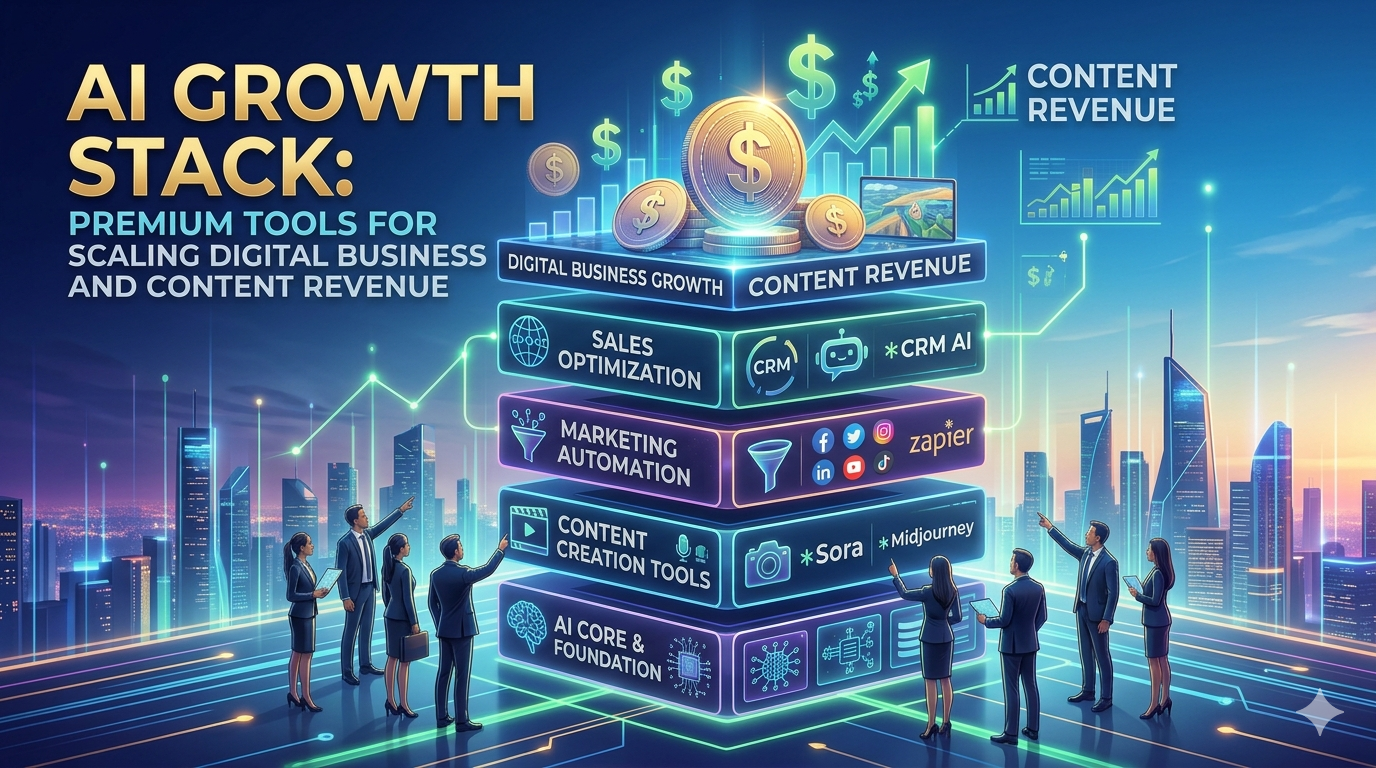
AI Growth Stack: Premium Tools for Scaling Digital Business and Content Revenue

The AI Revenue Architecture 2026: Building Scalable Digital Income Systems with Autonomous Intelligence

In 2026, digital growth is no longer defined by how much content you produce, but by how intelligently your systems generate revenue.

The evolution of AI has moved beyond simple assistants. We are now operating in an era of autonomous intelligence systems—where creators and entrepreneurs build structured “income architectures” powered by interconnected AI tools.

Instead of working harder, modern digital businesses are designed to scale through systems, automation, and optimized workflows.

This guide breaks down how to assemble a high-value AI stack that supports scalable content production, business automation, and monetization efficiency.


1. Intelligence Layer: Research, Strategy & High-Value Content Creation

Every high-earning digital system begins with intelligence—data, insight, and strategic direction.

Modern AI tools now function as a real-time research and decision support layer.

Key Tools in This Layer:

  • Gemini 3 – Used for strategic insights, trend forecasting, and market direction analysis.
  • ChatGPT-5 – Supports structured content creation, ideation, and business planning workflows.
  • Perplexity AI Pro – Provides real-time sourced information, ideal for finance, SaaS, and technology content.
  • Claude (Advanced Models) – Helps generate natural, persuasive, human-like content for blogs, landing pages, and scripts.

Purpose of This Layer:
Instead of guessing what performs well, creators now rely on AI-driven insights to identify high-value topics with strong commercial intent.


2. Creative Production Layer: Visual Identity & Automated Content Output

In modern digital business, visual quality directly impacts trust, engagement, and conversion rates.

AI now enables production-level content without traditional design or video teams.

Key Tools in This Layer:

  • Sora – Text-to-video generation for cinematic marketing content.
  • Runway Gen-3 – Advanced AI video production for ads, reels, and faceless content.
  • Midjourney v7 – High-quality AI visuals for branding, thumbnails, and marketing assets.
  • Canva Magic Studio – Fast content creation for presentations, social media, and digital branding.

Purpose of This Layer:
To build consistent, professional-level branding assets that improve click-through rates, engagement, and audience trust.


3. Automation Layer: Business Systems & AI Workflows

True scaling happens when human effort is reduced and workflows are automated.

This layer transforms AI tools into operational systems that run continuously.

Key Tools in This Layer:

  • Zapier Central – Connects multiple applications into automated workflows across business operations.
  • Intercom Fin – AI customer support system that reduces workload while improving user experience.
  • Notion AI – Central workspace for managing content strategy, planning, and knowledge organization.

Purpose of This Layer:
To build a system where tasks such as lead handling, content scheduling, and customer support are partially or fully automated.


4. Monetization Strategy Layer: High-Value Traffic & Revenue Targeting

The most profitable AI systems are built around high-commercial intent niches.

Instead of broad topics, focus is placed on keywords and industries that attract premium advertisers.

High-Value Keyword Directions:

  • AI workflow automation for business operations
  • Enterprise AI tools for SaaS growth
  • AI-powered CRM systems for scaling startups
  • Autonomous lead generation systems
  • Financial forecasting using AI systems

These topics typically attract advertisers from:

  • SaaS platforms
  • fintech companies
  • enterprise software providers
  • automation tools and AI startups

5. System Building Roadmap: From Tools to Revenue Architecture

Building a digital income system is a structured process—not a random collection of tools.

Phase 1: Foundation (Weeks 1–2)

Focus on:

  • content intelligence
  • AI-assisted research
  • visual content creation

Phase 2: System Integration (Weeks 3–4)

Focus on:

  • workflow automation
  • AI agents
  • content pipeline structuring

Final Outcome:

A self-operating digital ecosystem capable of generating consistent content, traffic, and revenue with reduced manual intervention.


Conclusion

The future of digital income belongs to those who build systems—not those who simply create content.

The AI Revenue Architecture 2026 represents a shift toward structured, automated, and scalable digital businesses powered by intelligent tools.

Success is no longer about working more—it is about designing systems that work continuously.


SEO Meta Data (Optimized Version)

Focus Keyword: AI Revenue Architecture 2026
Secondary Keywords: AI business automation, scalable digital income systems, AI content creation tools, autonomous AI workflows, high CPM AI niches

Slug: /ai-revenue-architecture-2026-digital-income-systems

Meta Description:
Discover the AI Revenue Architecture 2026—a structured system for building scalable digital income using autonomous AI tools, automation workflows, and high-value monetization strategies.

Categories
AI Tools

Step-by-Step Guide to Creating an AI-Powered Faceless YouTube Channel

The Ghost-Creator Blueprint: How to Engineer a Viral Faceless YouTube Channel Using AI Agents in 2026

Forget everything you know about YouTube. The era of the “talking head” is evolving, and on the frontier is a silent revolution. In 2026, building a highly profitable, scalable content empire no longer requires a camera, a professional studio, or even a human host. Enter the AI-powered faceless YouTube channel.

With the recent explosion of AI agents—autonomous software capable of reasoning and executing complex workflows—anyone can now step into the role of an “Anonymous Architect,” orchestrating an entire production team from a single prompt. This is not just automation; this is intelligent YouTube automation on autopilot.

This guide provides the complete 30-article roadmap to turn this opportunity into a high-ROI business. From day one to full monetization, this is the Ghost-Creator Blueprint.


The Core Blueprint: 5 Critical Steps

The blueprint is structured around five foundational pillars that take you from concept to a self-sustaining AI-driven channel. Advertisers love this model because it guarantees efficiency and targets specific High Commercial Intent audiences.

Step 1: Laying the Foundation – Choose Your Niche (High Commercial Intent)

The first and most critical decision is your niche. Because you can generate high-quality AI visual content and AI voiceovers for any topic, you must prioritize niches that maximize revenue (RPM/CPM). This makes your channel incredibly attractive to high-paying advertisers.

High-Profit Niche Examples (Advertiser Favorites):

  • Autonomous Finance & Crypto: Explain complex DeFi protocols, analyze markets using predictive analytics AI, or teach passive income strategies. High advertiser demand from fintech companies.

  • Deep-Dive AI & Technology Documentary: Explore the evolution of AGI, review enterprise AI SaaS, or teach advanced coding without needing a CS degree (perfect for freelancers).

  • Performance Productivity & Self-Improvement: Create content around “building a second brain” or implementing AI for workflow efficiency. High-budget advertisers from the e-learning sector.

Targeting these niches ensures you are generating content that attracts high-value audiences.


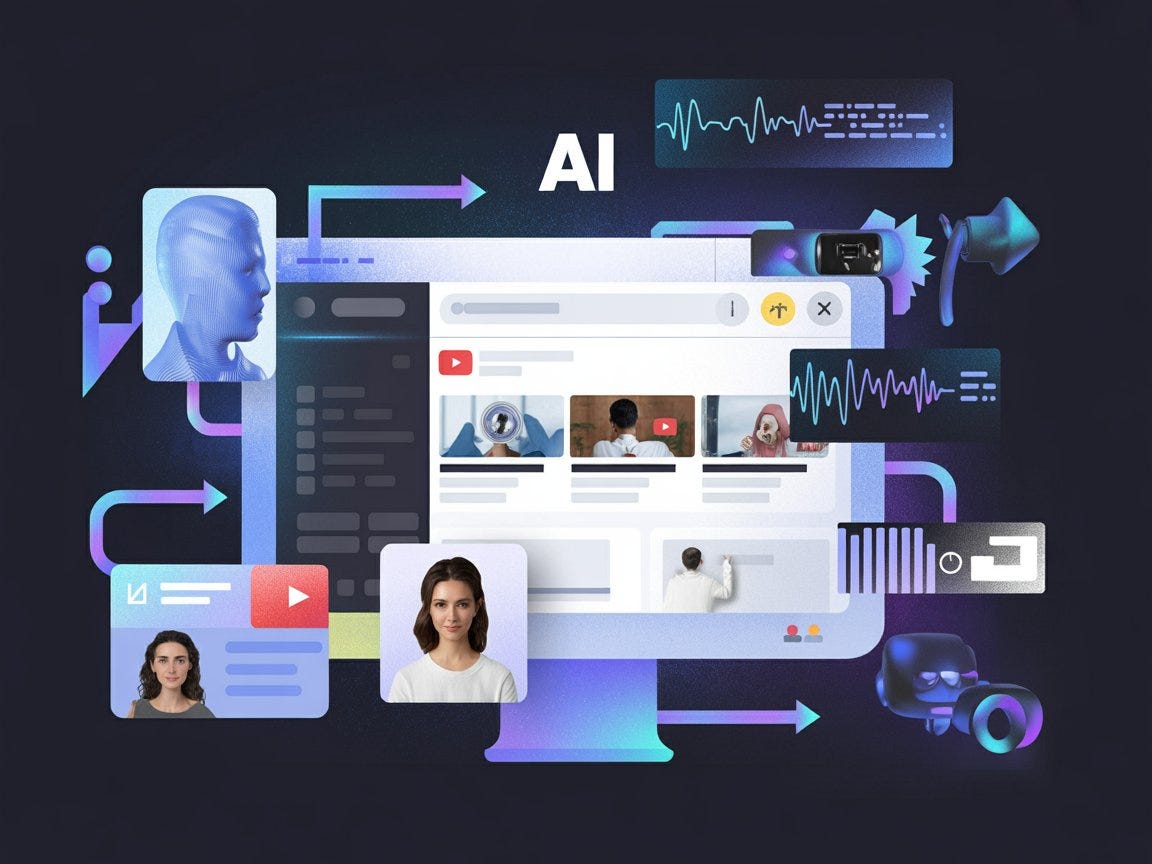
Caption: The Blueprint in action: First, select a High Commercial Intent niche using data (left). Second, engineer the script with complex prompting and generate the ethical AI voice (middle). Third, render cinematic AI video (right) to complete the production workflow.


Step 2: Branding Your Anonymous Empire

Once your niche is defined, you must build a strong visual identity. Your audience won’t connect with a face, so they must connect with a consistent personal branding aesthetic.

Use Midjourney v7 (or the latest version) and Canva Magic Studio to:

  • Generate a unique, recognizable logo.

  • Create consistent video thumbnails with high emotional pull.

  • Develop a professional channel banner and end-screen templates.

Step 3: Architecting the Script and Voice

This is the thinking layer where you set yourself apart. Instead of simple chatbots, you will use advanced Prompt Engineering 2.0 techniques like Chain-of-Thought and Multimodal Prompting.

The Production Stack:

  1. Script: Use Gemini 3, Claude for Creative, or ChatGPT-5 to research and draft deeply researched, compelling scripts. A single complex prompt can outline, research sources using Perplexity AI, and then draft a full script.

  2. Voice: Upload your finalized script to ElevenLabs to generate an ethical, human-like voiceover that captures emotion and nuance. Select a distinct voice profile for consistency across your entire channel brand.

Step 4: Generating Stunning Visuals Without a Camera (The Viral Layer)

In 2026, the visual limitation is your imagination. You can now create professional-grade video advertising without traditional filming.

Tools for Virality:

  • OpenAI Sora & Runway Gen-3: Use text-to-video AI video generators to create hyper-realistic or stunningly creative b-roll, atmospheric establishing shots, or entire 60-second scenes on demand.

  • Adobe Firefly & Photoshop: Master Generative Fill for unique background creation or photo manipulation to create compelling storytelling visuals.

  • Suno & Udio: Generate an original musical score and background ambiance for every video to establish a unique sonic brand.

Step 5: AI-Driven Assembly, SEO, & Publishing (The Efficiency Layer)

Finally, put everything together. AI streamlines the editing process and handles the optimization of your faceless YouTube channel.

  • Assembly: Use tools like Descript (to edit video via text transcript) or a specialized AI Meeting Assistant (to pull key insights if your video is based on interview/lecture sources). Tools like Gamma can quickly generate presentation decks for educational content.

  • SEO: Implement a complete SEO audit using an AI-driven SEO tool (like YouTube Copilot within VidIQ or TubeBuddy) to generate a clickable title, detailed description, and optimized tags. Your goal is to satisfy both human curiosity and the YouTube search algorithm.

  • Community Management: As your channel grows, integrate AI personal agents to manage comments, handle basic Intercom Fin style customer support, or automate social media promotion using Zapier Central.


The Ultimate 30-Article Roadmap to YouTube Automation Success

This blueprint is part of a complete 30-article roadmap designed to take you from a curious beginner to an advanced AI operator. Below is the full content plan:

Part 1: Foundations & The Thinking Layer

Article Topics: AI Literacy, Advanced Prompting (Chain-of-Thought), Multimodal Tools (Gemini/Claude), Privacy & Data Security, SEO vs. Perplexity Research.

Part 2: Creativity Visual & Audio

Article Topics: Midjourney v7/DALL-E 3 Branding, Canva Magic Studio, Generative Video (Sora/Runway), Ethical Voice Cloning (ElevenLabs), Original Music Generation (Suno/Udio).

Part 3: Productivity & Otomasi

Article Topics: Notion AI Second Brain, Spreadsheet Analysis, Meeting Assistants, Custom GPT Agents, Zapier Central Automations, Non-Programmer Coding Tools.

Part 4: Implementasi Bisnis & Karir

Article Topics: How to Make Money with AI Tools, Personal Branding Optimization, E-commerce/Chatbot Integration (Intercom Fin), Predictive Marketing, Etika & Regulasi 2026, Deteksi AI & Transparansi.


Conclusion: Preparing for 2027 and AGI

By the end of this journey, you will not just have a successful YouTube channel; you will possess the skills of a modern “Anonymous Architect,” fluent in the language of AI production.

As we move toward AGI (Artificial General Intelligence) in 2027, the demand for human curators and orchestrators of AI will only grow. This roadmap gives you the competitive advantage to not only survive but thrive in the new automated economy. Build your empire. Build it silently. Build it with AI.

Categories
AI Tools

Best AI Tools for Business 2026

The business landscape in 2026 has moved past the “AI hype” phase and into a period of deep integration. Today, artificial intelligence isn’t just a chatbot on a website; it’s the engine driving operational efficiency, predictive strategy, and creative scale.

​If you want to stay competitive, you need the right stack. Here is a curated list of the best AI tools for business in 2026, categorized by their impact on your workflow.

​1. The All-Rounders: Multi-Modal Ecosystems

​In 2026, the best AI tools are “agentic,” meaning they don’t just answer questions—they execute tasks across different apps.

  • Google Gemini (Enterprise): With the integration of Gemini 3 Flash, businesses are using it for real-time data processing and seamless collaboration across Google Workspace. Its “Live Mode” allows teams to brainstorm via voice in real-time, making it an essential tool for remote strategy sessions.
  • OpenAI ChatGPT Enterprise: Still a powerhouse for complex reasoning and custom GPTs. In 2026, its memory capabilities and “Operator” features allow it to manage schedules and handle complex research chains autonomously.
  • Claude 4 (Anthropic): Known for its high ethical standards and massive context window, Claude remains the favorite for legal, technical, and long-form document analysis where precision is non-negotiable.

​2. Content Creation & Marketing Automation

​Marketing in 2026 is about hyper-personalization at scale. These tools allow a team of two to do the work of twenty.

  • Jasper & Copy.ai: These platforms have evolved into full-scale marketing operating systems. They don’t just write blogs; they analyze your brand voice and automatically generate multi-channel campaigns (email, social, ads) that align with your 2026 SEO strategy.
  • Midjourney & Google Veo: For visual branding, these tools provide studio-quality assets in seconds. Veo is particularly revolutionary for businesses needing high-fidelity video ads with natively generated audio, cutting production costs by up to 80%.
  • Canva Magic Studio: The go-to for non-designers. Its AI-driven “Text-to-Graphic” and “Magic Switch” features make localized global marketing a breeze.

​3. Operations and Workflow Automation

​Automation is no longer about simple “if-this-then-that” logic. It’s now about AI agents that understand context.

  • Zapier Central: This allows businesses to teach AI agents how to behave across 6,000+ apps. You can essentially build a “Digital Employee” that monitors your inbox, updates your CRM, and alerts sales leads without writing a single line of code.
  • UiPath Autopilot: For enterprise-level automation, UiPath uses specialized AI to discover bottlenecks in your business processes and fix them automatically.

​4. Data Analytics and Business Intelligence

​In 2026, you don’t need to be a data scientist to get insights. You just need to know how to ask.

  • Tableau Pulse: Powered by Salesforce Einstein, this tool proactively surfaces insights. Instead of you checking a dashboard, the AI “pulses” you when it detects a trend or an anomaly in your sales data.
  • Microsoft Fabric: A unified analytics platform that uses Copilot to turn raw data into actionable PowerPoint decks or Excel models via simple natural language prompts.

​5. Customer Experience (CX)

​Customer support has shifted from reactive “FAQs” to proactive “Success Agents.”

  • Intercom Fin: The gold standard for AI customer service. In 2026, Fin can resolve over 50% of complex support tickets instantly by accessing your company’s entire knowledge base and past interaction history.
  • Lately.ai: This tool analyzes what your audience is talking about and helps your social media team join the conversation with the right tone and timing, boosting organic engagement significantly.

​Key AI Trends to Watch in 2026

​To maximize your ROI, keep these two trends in mind:

  1. Agentic AI: We are moving from “Assistants” (that suggest things) to “Agents” (that do things). The best tools in 2026 are those that can navigate your software on your behalf.
  2. Privacy-First AI: With stricter global regulations, tools that offer “Local LLMs” or “Zero-Data Retention” (like the Enterprise versions of Gemini and ChatGPT) are becoming the standard for sensitive industries.

​Summary Table: Which Tool for Which Task?

Business Need

Recommended Tool

Top Feature

Daily Productivity

Google Gemini

Live voice collaboration & Workspace integration

Video Production

Google Veo

High-fidelity video with native audio

Sales Automation

Salesforce Einstein

Predictive lead scoring

Content Strategy

Jasper

Brand-aligned multi-channel campaigns

Task Automation

Zapier Central

Training custom AI agents for workflows